How do we make the value of foresight visible without flattening it into yet another KPI? Our first online gathering of the Oceania Futures Network considered this critical question at its first meet up. Guest presenter Sabrina Sullivan sharing her vast experience and research findings. Sabrina is a Canadian foresight, researcher, and founder of by+by foresight, based in Calgary, Canada. She is one of the co-authors of the Foresight Spectrum, a global research project exploring the roles and “enablers” that shape foresight practice.
We considered questions such as: Why is it important to get a better handle on impact now? How have we tried (and struggled) to measure foresight in the past? What more creative, relational, or systemic ways might we design for impact with the stakeholders we work alongside?
This year I have a particular focus on impact we have in our work as futurists and foresight practitioners. This focus is not just on the impact on business, but on people and planet – futuring for good. I was intrigued by the research Sabrina and Deborah Hayek presented at the Dubai Future Forum. Their subsequent Foresight Spectrum substack posts provide excellent deep dives!
Their research involved over 100 foresight practitioners globally, revealing why traditional measurement systems fail our work and what we might do about it. Interestingly, “The Evaluator” emerged as one of the least-selected foresight enablers in their global research. Yet it seems to me to be critical in building our credibility and professional practice. My notes are summarized below:
Invisible Foresight Impact
Organisations typically measure performance through short horizons, linear cause-and-effect, and numeric proof. None of these align with how foresight creates value through cognitive shifts, cultural influence, resilience building, and decision relevance.
The research identified three ways foresight impact typically shows up, often months or years after initial work. It can be
- invisible (hard to point to on a slide)
- indirect (part of a wider decision story), or
- delayed (showing up months or years later).
Foresight is working in the shifts before the shift. It’s in those mental models, those team postures, those organisational directions. But we need to figure out different ways to capture that impact.
Sabrina Sullivan
The lag effect can mean that institutional memory and connection can be lost entirely if personnel change, especially key enablers within the organisation.
Four Dimensions of Impact
Through their research, Sabrina and Deborah identified four areas where foresight practitioners see impact:
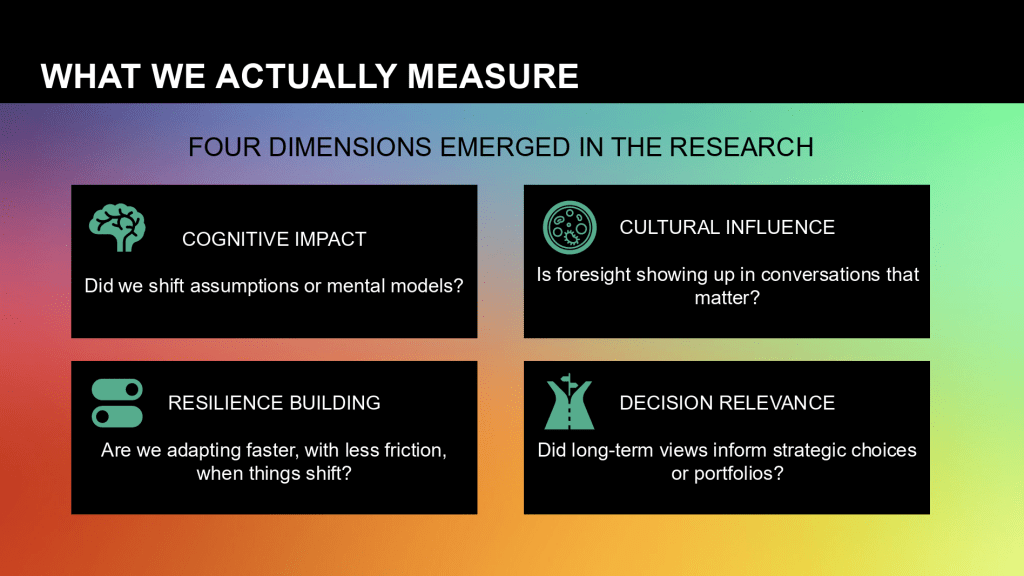
- Cognitive impact shifts assumptions and mental models. This is the head-nodding, the moment when someone’s eyebrows jump upwards in recognition.
- Cultural influence is where foresight gets called into conversations. Moving from being asked for “the future of luxury in China” at the last minute to being embedded in advanced product development from the start.
- Resilience building is how organisations adapt faster, with less friction, when disruption hits. This proved the most difficult to measure, yet practitioners considered it critical.
- Decision relevance is where long-term views inform strategic decisions and portfolios—not in an “I told you so” way, but as genuine contribution to better choices.
Front Ending Impact
Sabrina suggested shifting measurement from a back-end problem to a front-end practice. I loved her framing of the “the prenup conversation” as a way of being explicit about the roles we all play up front. Her suggestions:
- Name the shift. What does success actually look like? This requires helping clients understand what foresight can offer, which is itself part of the work.
- Identify who will notice. Rather than hoping someone somewhere saw the impact, name specific people positioned to observe change.
- Choose good-enough indicators. Not perfect metrics, but signals that matter eg shifts in language, questions being asked, or when foresight gets ‘invited into the room’.
- Set the date. Schedule the impact review conversation upfront to provide continued momentum and maintain engagement.
Context Shapes Measurement
The research revealed some key differences between internal and external practitioners. Those working inside organisations focused on cultural and cognitive shifts—the slow burn of transformation. They measured through moves like securing 10-minute “foresight ripple” conversations in regular leadership forums, or building reflection questions into standard templates.
External consultants (where I fit in), aimed for catalytic insights and concrete decision shifts. But they faced a different challenge: contracts end, and without ongoing relationships it can be difficult to track what happens next. Measurement relies on creating internal allies and embedding “success signals” that outlast the consultant engagement.
As part of my own impact focus I have developed a personal reflection checklist for key ambassadors within client organisations, scheduling a 100-day follow-up to discuss what has changed. I have also provided guidelines for organisations to embed futures thinking and foresight in all their systems.
The Courage to Try
One of the key messages of the workshop was for foresight practitioners to be courageous and willing to give ideas a go by developing systems that capture preparedness, expanded possibility and adaptive capacity. This means us pushing back on requests for tidy numbers when the real value lies in questions asked, relationships built and assumptions challenged. It means accepting that sometimes there won’t be measurable impact, solutions won’t be perfect but ‘good-enough’ experiments that we can learn from together.
From a personal perspective it also means having the courage to grow new approaches to futuring, embedded in indigenous ways of knowing and connection with earth, sea, sky and nature and reminding myself that impact can and should look different for our contexts.
The Challenge
As organisations grapple with complexity and uncertainty, the ability to think differently about the future becomes increasingly valuable. The challenge for us as foresight practitioners isn’t proving that value exists. It’s developing the language, tools, and confidence to make it visible in ways that matter to decision-makers.
The conversation ended with the following reflective questions:
- What part of your foresight practice has made the biggest difference lately — and how would someone else describe it?
- Where is foresight hiding in your outcomes?
- What would it look like to reimagine measurement so it captures preparedness, expanded possibility, and adaptive capacity?
At our next gathering we will reflect on this excellent introduction, sharing new ways we have been measuring impact. In this way it considers how our first online gathering for 2026 has impacted us. What have we learnt?
You can find out more about our next Oceania Futures Online at Foresight Impact Sharing
If foresight teaches us anything, it’s that the future gets built through small shifts in practice, accumulated over time, by people willing to try.
The Oceania Futures Network
The Oceania Futures Network is an informal group meeting online monthly to share practice and to grow expertise in futures thinking and foresight across the Oceania region focusing on Aotearoa New Zealand, the Pacific and Australia. It enables those ‘down under’ to connect in a friendly time zone and reflect on the world views that are unique. We also have a LinkedIn page for those in our region.
Image by Cornell Frühauf from Pixabay