At the Oceania Futures and Foresight Symposium Alice referred to Hopepunk and this really resonated with all in the room. Afterwards, I fished back in my archives to a youth workshop I facilitated in 2023 at the University of Canterbury. We hosted the amazing Sophie Howe, the first Commissioner for Future Generations in Wales and I used the idea of Hopepunk to frame the session.
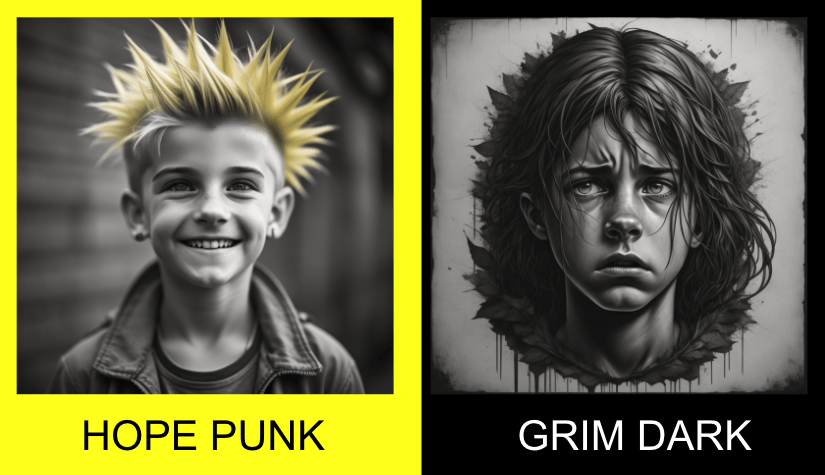
If you haven’t come across the term before, hopepunk is a speculative fiction subgenre that sits at the opposite end of the spectrum from grimdark. Author Alexandra Rowland coined the term in 2017 to describe stories where characters fight for positive change through kindness, community, and hope — even when everything around them is falling apart. The central idea is that choosing to care is a brave, deliberate act of rebellion.
Key Features
Hope as Resistance: Hopepunk pushes back against the idea that cynicism is the smarter or more sophisticated position. Staying optimistic in the face of despair is treated as a conscious political act — essentially a weapon against hopelessness itself.
Community over Individualism: Characters in hopepunk stories succeed through collaboration, empathy, and chosen families. Solo heroics take a back seat to collective effort and mutual support.
Not Naïve Optimism: Hopepunk doesn’t pretend the world isn’t broken. Characters face real hardship and struggle, but they keep working toward something better regardless of the odds. It’s grounded, not idealistic.
“Softness” as Strength: Where grimdark tends to equate brutality with power, hopepunk treats kindness and compassion as genuine strengths rather than liabilities.
What if the future isn’t something we predict — but something we actively choose to believe in? 🌱
Why we need this
As I write this, the world seems more grimdark. Violence, aggression and testosterone fill the airwaves. Our senses are constantly assaulted with stories that can send us down rabbit holes spiralling into despair. Yet we do have agency over our own thinking and that is why it is worth revisiting Hopepunk. It’s not Pollyanna or head in the sand. It is a deliberate futures path that requires just as much, if not more, strength.
What if Hopepunk becomes our mantra?
Let’s spend less time doomscrolling and more time connecting positively. One conversation at a time.
[…] Alice Dimond discussed empowerment and agency, reminding us of the concept of “hope punk.” [I have written some more about hope punk here.] […]
Love this sooo much! Grow this precious becoming… 🙏🏻
Continue Reading
Futures CoLab
Futures thinking is often mentioned but rarely understood. It demands mental flossing and the ability to think both critically and creatively. Our increasingly polarised and complex world needs new approaches. Join Dr. Cheryl Doig, futurist at Think Beyond, for enriching collaborative conversations that will ground you in futures approaches.
Oceania Futures
Following the Aotearoa Futures Forum 2026 fourteen practitioners, leaders, and activators from across Oceania gathered to explore what makes Oceania futures practice distinctive.
Our conversation moved from “What future do we want?” to “What are we being called to care for?” This question guided us as we continued to explore the future of our region. We recognised that some callings are global but we also considered the specific characteristics related to our contexts – personally, nationally and across Oceania.
Future Recommended Reading 2026
Futures and foresight recommended reading for 2026. Enjoy this incomplete compilation of our favorites and share your own with us. This comprehensive list is for those who want to learn more about futures thinking, extend understanding or challenge assumptions and worldviews.