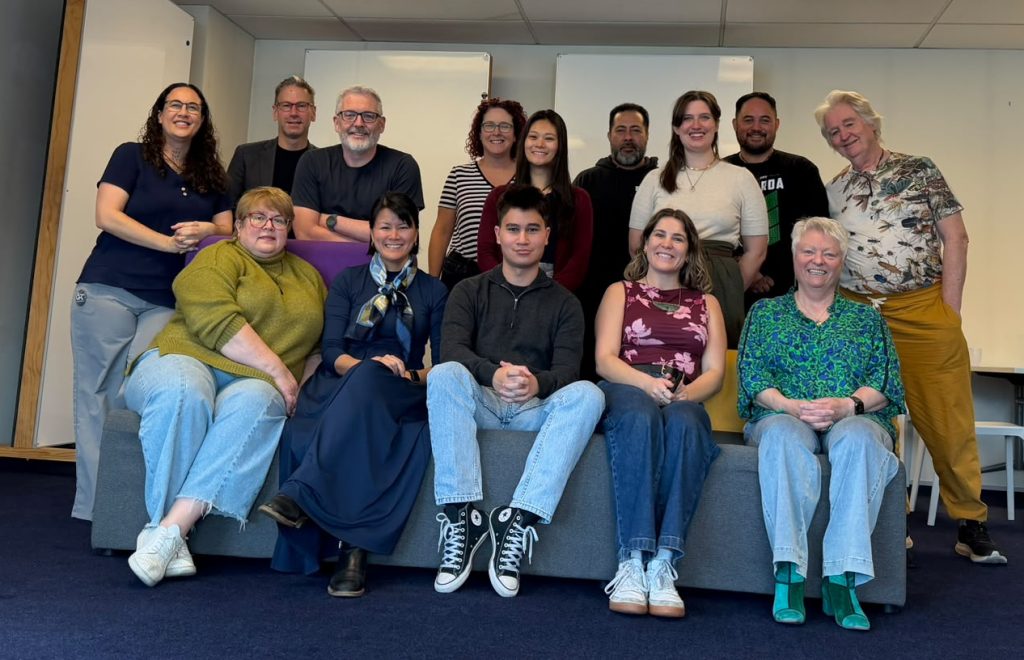
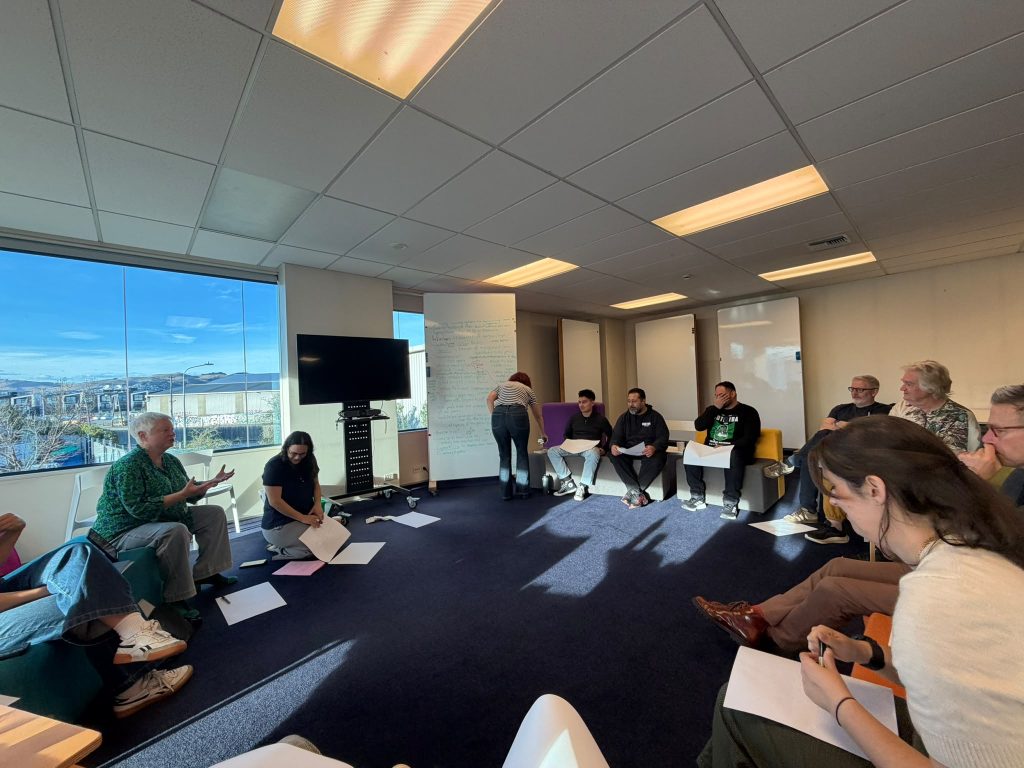
Following the Aotearoa Futures Forum 2026 fourteen practitioners, leaders, and activators from across Oceania gathered to explore what makes Oceania futures practice distinctive.
Our conversation moved from “What future do we want?” to “What are we being called to care for?” This question guided us as we continued to explore the future of our region. We recognised that some callings are global but we also considered the specific characteristics related to our contexts – personally, nationally and across Oceania. Our workshop findings have been summarised in Te Moana o Anamata An Emerging Oceania Orientation to Futures Practice. We invite you to explore the document and to join the conversation.
What are we being called to care for?
Oceania futures
The Metaphors of Oceania
Many of the metaphors that emerged from our dialogue related to weaving, wayfinding and patterns of time.
The cultural nuances of our region are diverse so one Pacific identity was seen as a form of erasure. An Oceania perspective honours distinct cultural identities. The “school of fish” metaphor was offered as a response to power struggles in the region. In this metaphor our region does not need to move in one direction, but can act collectively to push back against dominant forces. Oceania is not made up of a small set of islands, but is recognised for its full scale and power as a Blue Pacific Continent.
This seems particularly important when our countries are focused on the Pacific as an Ocean of Peace yet have China testing nuclear-capable weapons into the South Pacific. It reminds us all of the global interconnections, geo-political tensions and the importance of our futures work being both local and global. We have collective strength through collaboration and relationships.
Another important metaphor discussed was the weaving of past, present and future. These unbounded futures are interconnected and non-linear. This is captured in the whakataukī:
Kia whakatōmuri te haere whakamua ‘I walk backwards into the future with my eyes fixed on my past.’
Are we any different?
In a recent Linked In post Pierre Volosin reflected on the differences between European and U.S. foresight practitioners. One of the key differences he identified was the Contrasting Values and Priorities Across Traditions. Based on his observations:
- European foresight is anchored in public policy, governance, and societal consequence
- U.S. foresight tends to be market-driven, action-oriented, and focused on organisational strategy
These approaches each have strengths and nuances shaped by different contexts. There is an opportunity to weave these strengths together and explore opportunities. And so there are many opportunities to weave Oceania differences into the futures ecosystem and to contribute something unique to the patterns.
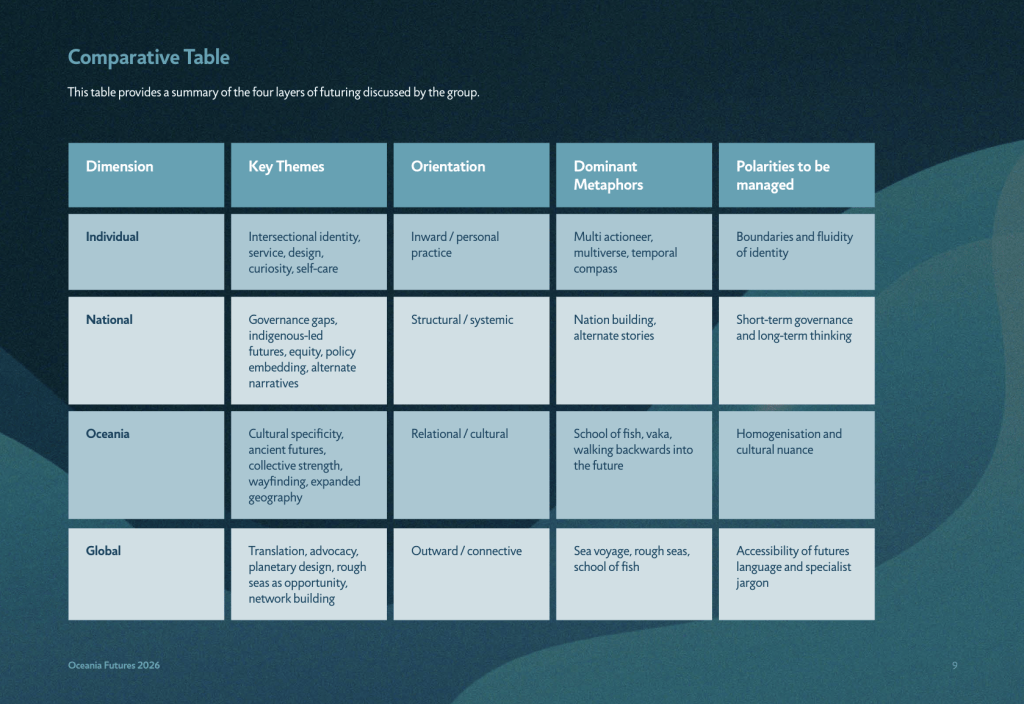
The comparative table below sheds some light on the differences identified during our workshop. Rather than tools and methodologies the opportunity is to explore world views, cultural nuances, relationships and connections.
The Invitation
Our conversations captured emerging observations of fourteen people involved in futures and foresight, some beginning their journeys and others with decades of expertise. Our aim now is to open the conversation to you all.
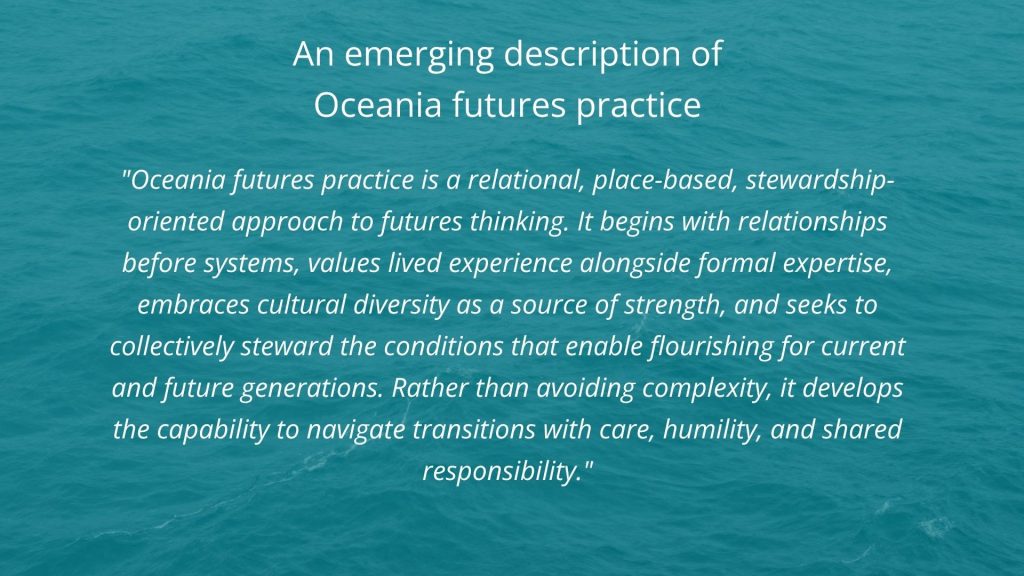
We have created the document summary and an emerging description of Oceania futures practice as an offering to connect, to grow understanding together and unweave to reweave.
- How might we grow a shared understanding of futures practice grounded in the realities, cultures, histories, relationships, and aspirations of Oceania?
- What futures practices are universal?
- What futures practices are uniquely ours?
Join the conversation.